The McCourt thing has got me thinking about education, teachers and such. That, and I'm a little health-updated out, so pardon the interruption
I've had the pleasure of studying with two singular educator/raconteurs: Frank McCourt, and Sidney Morgenbesser. Though better known these days for his second act as a best-selling author, McCourt's first act as a teacher of lord knows how many thousands of budding writers no doubt built the fan base for his future success. Morgenbesser was a philosophy professor at Columbia who despite very thin publishing credits, was revered as one of the great wiseacres and skewerers of pomposity in the western world. Mention to any philosopher, economist or political scientist that you studied with Sidney, and you will be greeted with a smile and a story about something Sidney said at a conference that broke up the room in laughter, while completely changing the way everybody thought about the subject at hand.
I have two vivid memories of something each of them said in class that have stayed with me all these years. I've come to realize that these very brief interludes informed nearly everything I've done in my working and intellectual life. It's kind of hard to process the notion that one sentence each by a philosopher and a creative writing teacher would matter to someone who has spent very little time at either of those endeavors, but facts is facts.
One day in creative writing class, McCourt began reading an assignment of mine aloud (I don't remember exactly what it was) that started off with the word "basically," as in "basically, what I mean to say is blah blah blah." He proceeded to tell me exactly why it was a bad idea to start a sentence with an modifier, or dangle one in any other fashion, and extended this to a mini lesson in applied sentence parsing. Never before had grammar or the mechanics of writing made any sense to me. Forever after, I understood that if you want someone to understand what you are trying to say, you have to say it clearly, succinctly, with a minimum of distraction from your point, and without ambiguity. That insight has enabled me to get my meager ideas across with enough success that I am reasonably frequently told that I am a good writer (which I am not, but mainly because of the meagerness of my ideas).
My great Sidney moment happened in a seminar on philosophy, economics, and Marxism he team taught with a fascinating figure named Alexander Ehrlich. Actually, the moment I'm going to tell you about was my second great Sidney moment. The first happened on the first day of class when he explained what the seminar was going to cover and how it was going to work, making liberal use of such technical philosophical terminology as "mishegas" "megillah" "famisht" "shmegegge" and "farblunget". In the middle of this, he stopped and announced to the class "by the way, a working knowledge of Yiddish is a requirement for this course". The next week (in time for the drop deadline) the herd had been culled of every blonde head.
OK actually, that was my second great Sidney moment. My first great Sidney moment came after in my first semester of CC (Columbia's core survey of western thought course) when I started giving serious thought to majoring in philosophy. I was talking about this with my father (an economist with Sidney stories), who simply told me "go talk to Sidney." I managed to find Sidney in his office, introduced myself as Peter Albin's son, and told him that I wanted to study philosophy. He asked me why, and I told him that I liked CC, had started reading some philosophy in high school and was interested in getting into the questions I had encountered more deeply. He asked me what I had read in high school and I said "oh you know, Carlos Casteneda, Zen and the Art of Motorcycle Maintenance, the Dancing Wu li Masters ..." Sidney smiled and said "so how's your dad?"
OK so my third great Sidney moment came when Sidney started talking about how Marx's only real important works were those that dealt with practical critiques and analyses of politics, society, and economies; that the early stuff was all fuzzy headed noodling; that as a grand scheme theorist there wasn't really that much to talk about. This was circa 1983, when there still was such a thing as communism, critical theory and post structuralism were at something of a zenith, everybody walked around with a copy of the Marx-Engels Reader, and the 1848 Manuscripts were being viewed as his Marx's deepest work.
So I said to Sidney, "what about alienation? Isn't that a deep idea? Doesn't it all hang off that?" Sidney said "Alienation schmalienation. What the hell is that? Can you define it?" And I couldn't (at least not in non-circular, non-mish-mosh terms), despite having read thousands of pages on the subject and written a number of A papers that claimed to talk about it. At that moment, I realized that it was possible to regurgitate jargon that either meant nothing or which you absolutely didn't understand without anyone being the wiser. Philosophy became pretty much a dead subject to me after that, which was a bit of a problem because I was maybe 20 credits into a 30 credit major. However, I have discovered that there is perhaps no better management tool than asking people to define their terms and explain in plain English why what they are saying is important.
Now if I could only figure out what the meshuganah Derrida was talking about ...
Tuesday, July 21, 2009


Tuesday, March 31, 2009
Can you verify?
All dialog guaranteed verbatim.
Literal Minded Bugger of a Customer: My social? I wasn't aware that this involved socials, or that dances had digits.
HCL: That would be your social security number.
LMC: Ah, why didn't you say so? Yes, I can verify the last four digits of my social security number.
[several seconds of silence]
HCL: Sir? Are you there?
LMBoaC: Yes, I'm still here.
HCL: Sir, can you verify the last four digits of your social security number?
LMBoaC: I said yes, I can. If you tell me the information you have, I'll verify it for you.
HCL: No sir, I need you to tell me the last four digits of your social security number.
LMBoaC: You want to verify what I tell you, is that it?
HCL: Yes.
LMBoaC: Ah, I see. You seem to have this a bit backwards. Why didn't you say so? The digits are XXXX [Those are not the real digits, by the way, or "BTW" for the youngsters in the audience. If I told all of you the real ones, you might be able to verify them, which would not be a good thing for me, I gather.]
HCL: Yes, and how can I help you this evening?
LMBoaC: Well, I've had an account with you for many years, and have always paid my bills on time, but for some reason, you have increased the interest rate on my card to 29 percent, and reduced the credit limit to $390. This would seem to indicate that you don't want my account anymore, so I would like to oblige you by closing my account.
HCL: Yes, I see from your account that you are a very good customer, is there anything I can do to change your mind?
LMBoaC: Can you restore my credit limit to $10,000 and the interest rate to 8.9%, which were the terms last month?
HCL: No, I can't, but I can give you a free gift.
LMBoaC: What would that be?
HCL: A credit card holder.
LMBoaC: Uh, no, that's OK. Just close the account please.
HCL: I'm sorry I can't do that. I will have to transfer you to someone else who can.
LMBoaC: Please do.
HCL: Before I transfer you, may I please have your daytime phone number?
LMBoaC: May I ask why?
HCL: For account maintenance purposes.
LMBoaC: Account maintenance purposes?
HCL: Yes, so that we can maintain your account.
LmBoaC: You mean the account that I am closing and will no longer be maintaining with your company?
HCL: Yes.
LMBoaC: Do you see the irony in that?
HCL: I'm sorry sir?
LMBoaC: Never mind. No you may not have my daytime phone number. Please transfer me to the person who can close my account now.
[Beep beep. Hold music.]
HCL#2: To whom do I have the pleasure of speaking
LMBoaC: Define pleasure. Oh never mind. John Albin, that's A-l-b-i-n [I always spell it because for some reason despite only two simple syllables, no one ever gets it.]
HCL#2: Yes Mr. [sounds like "elbow"], how may I help you this evening?
LmBoaC: I would like to close my account?
HCL#2: Oh, I'm sorry to hear that, may I ask why?
LmBoaC: Well you've changed the terms so as to make it unusable, and I have other cards that are better, so I don't see the point in keeping an account that you clearly don't want.
HCL#2: I'm sorry to hear that, is there anything I can do to change your mind?
LMBoaC: No thank you.
HCL#2: I'm sorry for the inconvenience, I'm sure you understand the reasons.
LMBoaC: It's no inconvenience to me. You're the ones losing my business.
HCL#2: Yes, but you understand that with the financial situation we have to change the terms.
LMBoaC: What financial situation? My account is in good standing. I pay my bills on time and rarely have a balance.
HCL#2: Yes, but the bank has been losing a lot of money.
LMBoaC: Not from me.
HCL#2: No sir, you are a very good customer.
LMBoaC: It's nice of you to say so. Please close the account now.
HCL#2: Yes sir. Is there anything else I can help you with?
LMBoaC: No thank you. Just close the account.
HCL#2: Just to let you know sir, after you close the account, you will not be able to use it.
LMBoaC: Yes, that's the point.
HCL#2: Your account is now closed. Sorry for the inconvenience.
LMBoaC: No inconvenience at all. Good night.
[Click]
The financial system is doomed.
Friday, March 27, 2009
Wake up and smell the coffee
Proust had his madeleine, and I have my burger, doughnut and coffee, one whiff of which is capable of launching me into an almost hypnotic state of nostalgia. It all goes back to an afternoon in the Village when I was maybe three or four years old. On the corner of Waverly Place and Sixth Avenue, there's a coffee shop. There has always been a coffee shop on the corner of Waverly Place and Sixth Avenue. These days, it's called the Waverly Diner, or something similarly logical. I think of it as the new place, even though it has probably been called that for 30 years.
Back in the day, though, it was called Twin Brothers, and it was a little more on the doughnut shop end of the continuum. Back in the day, most diners were, and most were called something like that -- Twin Brothers, Four Guys, Three Joes. They all had the same neon and chrome motif, white Formica counter, soda fountain, round stools that a little kid can spin around on, and the smell of burgers, doughnuts, and coffee.
At the time my family was living a few blocks away on the corner of Houston and Sixth, and we had some interesting neighbors, as people in the Village tended to have back then. Next door to us was a divorced mom named Cathy Phelps, with two kids about the same age as my sister and me named Peter and Susie. It's not a given in New York that two families with kids the same age living next door to each other will become friends, because nothing interpersonal is a given in New York, but we did in fact all become friends.
Elsewhere in the building, there was a guy named Bob Gibson. He had three daughters who were quite a bit older than us, and baby sat from time to time. Bob was a famous folk singer, a prominent member of the generation that immediately preceded and mentored Bob Dylan, Phil Ochs, Joan Baez, and the like. My parents were sort of beatnik-ish, and deeply involved in the anti-war movement, civil rights, and lefty causes, which made "folk singer" a respected profession in our household.
At the age of three or four I was only very dimly aware of any of this sociology, but it was part of the background of life, and I was aware that Bob was somebody. I was also dimly aware that there was something dark and wrong about him, that made others wary. I have learned (through family reminiscence and reading up on the folk scene) that what was wrong was drug addiction. Bob also had a brother named Jim, who wound up moving in with and marrying Cathy next door and become a presence in our lives thereafter (and who may also have shared some of his brother's troubles, though I'm not clear on this).
So anyway, there we all were, folk singers, junkies, college professors, divorcees, lovers, teenage daughters, and little kids in and out of each others apartments doing what ever it is that such people do. [I can't speak for anyone else, but I had a serious Tinkertoy jones] Though they were little more than kids themselves, my parents tended to be the most adult and level headed figures around. My father was often the only male possessed of basic urban family preservation instincts and common sense, and my mother was often the only female who knew how to keep people fed and clothed, acting as a den mother to all manner of strays throughout the sixties.
Anyway, where were we? Ah yes burgers, doughnuts and coffee. One thing that was definitely not a regular feature of daily life in the level-headed beatnik home was greasy spoon food. My mother was a relatively serious cook and homemaker, and my parents were relatively broke in those days, so we didn't routinely go out for snacks, and when we did, they tended to be wholesome. So one day, one of the Gibson girls (I don't remember any of their names) invited me on an adventure in search of snacks, and she took me in hand to Twin Brothers. Immediately upon entering, I was greeted by the combined aroma of burgers on the griddle, coffee, and fresh doughnuts. I spun around in circles on the stool and cautiously accepted the Gibson girl's offer of a bite of burger, a jelly doughnut and a glass of chocolate milk, sensing somehow that all this was contraband.
Soon, the snack was over, and it was time to head back down Sixth to Beatnik Towers. We arrived home to furor and panic, my father searching the streets, my mother ready to call the cops, and Gibson adults in high dudgeon. It seems that not only was the snack itself contraband, but conveying me to said snack without proper notice and authorization was a rather serious transgression. After that incident, to the best of my recollection I was no longer entrusted to any Gibson girls, and I believe that very shortly after Bob's family imploded and disappeared from Beatnik Towers.
Ever since then, any time I have walked into or past a greasy spoon or doughnut shop and encountered that combination of aromas, this narrative plays out in my mind, with a vibrancy and certainty as strong as anything else in my memory. Literally, every time for my entire life, a jelly doughnut can serve up near total recall of an event that happened at the edge of memory and experience. It also triggers a flood of memories about Cathy, Jim Peter and Susie, and the ways we would exit and re-enter each other's lives over the following decade or so, which is a story for another day. Perhaps I'll head down to the coffee shop for a jelly doughnut and a glass of chocolate milk, find a Bob Gibson record on iTunes and see what happens.
Friday, January 30, 2009
Do I know you?
The fall of 1981 marked the beginning of my sophomore year at Columbia University, and what I thought would be a year full of positive changes. My freshman year and the summer after had been kind of tough. As a native New Yorker, at a time when Columbia had a housing shortage, I was unable to get a dorm room. I spent the first semester living at home in the Village and commuting uptown, and had a hard time making friends and working my way into college life.
For my second semester, I lived in a fraternity that made animal house look like a chapter of the John Birch society. I started making friends on campus and and fitting in a bit better (living in what was easily the largest warehouse of illicit substances west of Lenox Avenue certainly helped), but it was all so drug addled and bizarre that rather than spending spring break attending the frat's week-long acid test, I retreated home and let my parents nurse me back to health and sanity. In the last month or so of the term, I had started a dating a senior girl who moved away after graduation. We traded visits over the summer, but it didn't really work out, and we wound up going our separate ways.
By the time the summer came to a close, I was ready for a bit of renewal and redemption. I still hadn't gotten housing from the college, so I wound up throwing my lot in with a colorful character named Michael Offen. Michael was a bit of a hustler in those days (and for all know, still is -- last I heard, he worked for Bear Stearns). He was the spitting image of Marty Feldman, with wild bulging eyes, curly hair, pointy features, and an amazing ability to charm people into whatever schemes he had going with girls, jobs, or school.
His father and uncle were involved in some sort of agribusiness, which led Michael to tell people that his father jerked off bulls for a living. His uncle (who visited us a couple of times), bore a striking resemblance to George C. Scott in his Patton days, and had been an intelligence officer before he turned to romancing livestock. The family had houses full of extra furniture, which was part of Michael's sales pitch for the tiny hovel he found for us at 142 West 109th Street, between Columbus and Amsterdam Avenues, a region the student guides warned us to avoid. [I still remember the address because I've been around that neighborhood for one reason or another enough times over the years that it has stuck.]
The first time we went to the building to check things out, there was an elderly disheveled hispanic woman cleaning the hallways. In a mix of hand gestures, and Spanish (she seemed not to speak English), she conveyed the notion that she was the super and would show us to our prospective new digs. We walked up to the third floor and arrived at a knobless, lockless door. We pushed it inward, and it fell off its hinges, revealing only gloom. The super made gestures suggesting it would be fixed, so we wrestled it to some sort of stability and proceeded.
The apartment consisted two small bedrooms, one of which had no door, a small living room, a large kitchen, and a bathroom. The bathroom had a tub without a shower, and no sink or mirror. The apartment had no closets, though there were hooks on the walls. The floors were rough unfinished wood, and the entire apartment was painted in high-gloss red enamel. Dead cockroaches littered the floor and a vague odor of decay filled the air. The apartment faced airshafts on all sides. As I stuck my head out the kitchen window to see if there was anything to see, a chicken carcass whizzed by and crashed into the debris-strewn courtyard below.
Despite missing the opportunity to read the entrails of the chicken, we interpreted all the omens to be good and decided to take the place. Sure it needed a little work, but we were young, school didn't start for another couple of weeks, we'd get the lease in our own names, and the price was right -- 350 bucks a month. Besides, it was the only apartment available that had real rooms. The others were all "railroads," and neither of us liked the idea of having to traipse through the other's bedroom. We made arrangements to return to the real estate office that had sent us there, eager to hand over our first and last month's rent and sign on the dotted line.
Later that day, we got our semoleans in order, and headed to an office on the upper west side to meet our landlord and close the deal. When we arrived, the "super" was there waiting for us, now well dressed, coiffed, and made up. The real estate agent introduced her to us as Mrs. Parada, the owner of the building. She greeted us in lightly accented, fluent English. I don't remember whether I was just to too stupid to see the mess we were getting ourselves into, or whether Michael pulled a Michael and convinced me that it was all copacetic, but no matter. We paid our money, took our chances, and spent the next week or so schlepping in our belongings, and getting the place as livable as possible.
The months that followed (surprise surprise) were absolute hell. We had an unexplained power outage that took days to resolve, a fire in one of the next door apartments, noisy neighbors, flocks of chickens and other detritus streaming past the airshaft windows, and a front door that continued to fall off its hinges. More importantly, as one of the coldest winters in recent memory descended upon us, Mrs. Parada showed her true colors, providing neither heat nor hot water for weeks at a time. We stalked Mrs. Parada and complained to every public official we could, but none of it helped. We took cold baths, and froze. The only solution was to spend as little time as possible in the place, shuttling between the library, the Hungarian Pastry Shop, the Marlin Cafe, and friends' apartments. Given the unfavorable male:female ratio in pre-co-ed Columbia, romance was rarely a refuge.
As we soon discovered, our surroundings also had some interesting, uh, economic activities. Car stripping was one of the main industries in the neighborhood. Every week or so, a new car would appear on the block. Men would emerge from adjacent buildings, plug power tools into the streetlight bases, and gradually reduce it to little more than a few bits and pieces sitting in a puddle of oil. Other cars would sprout new fenders, bumpers , and trim, which were, miraculously, the same color as the car that had shed its skin. There was a curious specialization to this. Our block was the Toyota-stripping block. One block west was strictly Datsuns.
The other big business in the neighborhood was, ahem, distribution of chemically active horticultural products. Liberally sprinkled around the neighborhoods to the east and north of Columbia were pot stores. Literally, these were stores that sold pot, either openly over a counter, or through a bank-teller like cage. The one I remember best was on Amsterdam Avenue, just below 110th Street. It had two signs, one above the door that said "Joe's Meat Market," and another painted on the window reading "Right-On Variety." I soon discovered, though, that there was more to the neighborhood than just retail outlets.
Not too long after I moved in, I went down to my parents' place for dinner, and my father drove me home. My father, who grew up on the upper west side, and knew every inch of Manhattan like the back of his hand, was very concerned about where I was living. He had been trying to talk me into moving back home. Hoping to convince him that everything was OK, on the drive uptown I told him not to worry. The neighborhood was poor, but the people were nice and it wasn't dangerous.
At the height of my spiel, we turned the corner onto my block and were stopped from proceeding by a police detachment. The street was full cops wearing bullet-proof vests and carrying rifles. There were snipers visible on the roof of one building. Learning that I lived on the block and was heading home, the cops let us through. As we reached my building, a couple was dragged out of a building a few doors down from mine in handcuffs. It was a major heroin bust that made all papers.
Fast forward to the end of the year, and I had had it. I sublet my share of the apartment to my buddy Tom Meltzer (sorry Tom), and moved back down to the Village to lick my wounds, and devote myself to earning enough money to stake myself to slightly better digs. As vivid as my memories of that apartment are, it strikes me that I remember almost nothing of any of my neighbors, except for another pair of friends (Gavin and Phil) suffering through a year of Parada-hell in the building next door. This is somewhat out of character, because in every other place I've lived, I've usually gotten to know or at least taken notice of my neighbors, many of whom I can still easily recall.
Fast forward another 27 years, and the subject of forgetting or failing to notice people has become current. Doing the math, my sophomore year beginning in 1981 puts me in the Columbia College class of 1984. A certain fellow named Barry-something-or-other (who has subsequently found a nice place to live) was class of '83, as were a number of my closest friends, including several with whom I am still in regular contact. So far, I've only come across one college friend who has any recollection of him. Still, he's obviously a hot topic of conversation, and every issue of every Columbia publication has had at least one item about alma mater's most illustrious alum over the past year or so.
Recently, while catching up via email with a high school friend who went to grad school there, we of course got on the subject of Obama's days at Columbia, and did you know him, and funny how no one seems to have, and all that, and he called my attention to a couple of items. One was an essay entitled "Barack Obama '83, My Columbia College Roommate" in the most recent alumni magazine. The author talks about how as junior transfer students from Occidental College in the fall of 1981, neither he nor Obama could get housing from CU, so they wound up sharing an unheated dump of a railroad flat on 109th between Amsterdam and Columbus. Hmm. It seems the president of the United States of America and I lived on the same block, under similar circumstances.
The other item was an article in something called WikiCU (a Wikipedia-like site devoted to Columbia trivia) about Obama's days at Columbia. Most of it is lifted straight from the roommate piece (or vice versa), but it also includes some additional detail, namely pictures of said dump and (a drum roll please) its address.
"#3E, 142 West 109th St"
Upon reading this, your faithful correspondent picks his jaw off the floor, and runs around his office shouting "holy shit! Barack Obama was my frickin' next door neighbor! Barack Obama was my frickin' next door neighbor! Barack Obama was my frickin' next door neighbor!" Now I suppose it's entirely possible that Barry is reading this and now running around his (significantly rounder) office and shouting "Holy shit! that guy who played at the Postcrypt all the time was my frickin' next door neighbor!" Then again ...
But even now, I must sheepishly admit that I still don't remember him. However, Barry, if you were the guy throwing chickens out the window, I've got a bone to pick with you.
Tuesday, January 13, 2009
White, You Huckleberry
When I was growing up, there were two kinds of people: Yankee fans and Mets fans. Red Sox fans didn't count as human, so the didn't fit into either category. Given this conceptual framework, I get some satisfaction out of the big news on the sports pages that feared Sox slugger Jim Rice finally made it into the Hall of fame, on the 800th ballot, or something like that, and Rickey Henderson (the most exciting Yankee of one of the team's most frustratingly underperforming incarnations) it in on the first try.
The less said about any Red Sock the better, except that by the numbers Rice was as deserving as anybody of election to the hall. That it took so long is probably not because he played for the Red Sox (unfortunately, the HoF voters do not understand the proper categorization of humanity). Rather, it was because the HoF is run by a bunch of sportswriters (i.e., over-aged nerds), who hold grudges against athletes who don't kiss their butts enough.
Speaking of butts, let's talk about Phil Rizzuto. Some years ago, I was watching a ball game on TV with my dad. Scooter and Bill White were calling the game, with the usual mix of Oh Holy Cowisms and disagreements, with White playing his usual role of straightman/huckleberry. Rickey Henderson was on first, taking a long lead, jabbering, twitching, and doing everything he could to drive the pitcher and catcher to distraction. He takes a big lead, and White says "there's Rickey taking that big lead." All of a sudden he's off. Before you can say, um, Jack Robinson, Henderson slides in safely, beating the throw by a mile.
White continues:
"That Rickey Henderson, he always gets that good jump"
"Yeah, he's so fast, too," adds scooter.
"Well, you know, he's got those powerful legs," says White.
"Yeah, and he's got cute buns, too," concludes Scooter. We all, dad, me, and White, fall off our chairs.
That's why there's a hall of fame.
Wednesday, January 07, 2009
Are you Jewish?
As many of you many know, Judaism is divided into four main streams of practice: orthodox, conservative, reform, and ambivalent. Most people would assume that the order in which these were just written reflects the gradual passage of the Jewish people into coexistence with the gentile world. Certainly the folks in black hats would have us believe that the most authentic form of the Jew is the most "traditionally" religiously observant and that relaxation of practice puts one on the slippery slope toward loss of one's very identity.
Interestingly, archaeology suggests that the opposite may be true. To vastly oversimplify, the historical portions of the bible say that god offered the descendants of Abraham a deal: worship me, and you get the promised land. On the way down through Moses, the deal got a bit more complicated and specific -- worship me, follow the laws, and wipe out the infidels who are living there despite the fact that I gave it to you, and you get the promised land. Along come David and Solomon, and a few more details get fleshed out as to the where's and how's of practice, and the Jews get the promised land, plus this really cool kingdom, a nice temple, yadda yadda. Fast forward lots of centuries, and we have a culture built around the idea of a covenant, liberation from slavery in Egypt, and the carrot of the promised land being dangled in front of us.
However, since the rise of modern archaeological techniques, and especially since Israel's expansion following the six-day war, there has been lots of opportunity to dig up the holy land. Lots of old cities have been found, lots of worship sites have been found. Evidence that many of the kings mentioned in the bible were real has been found. The problem is, most of this evidence suggests that the kingdom of David was relatively modest, and that the Israelites were consistently polytheistic (rather then errantly monotheistic), until hundreds of years later than traditional readings of the bible suggest. More importantly, no evidence of the exodus has been found, and other finds filling in the context of the ancient world make it extremely unlikely that it occurred on anything like the temporal or physical scale described in the bible, if it occurred at all.
Or so argues a book I've recently read called "The Bible Unearthed" by archaeologists Israel Finklestein and Neil Asher Silberman. Assuming that the narrative F&S lay out is accurate (and a even a cursory survey of the literature on biblical archaeology threatens the certainty of such an assumption, which never stopped me before ...), the greatest significance of this story is that traditional orthodoxy is actually the most recent, and least historically grounded of the forms of practice. Ambivalence about god and monotheism, ambiguity of identity, intermingling with other peoples, and picking and choosing which religious laws and practices to follow or ignore is the most traditional path of all.
As a fourth generation, smart-assed New York atheist Jew, this is a combination of comforting and disturbing. On the one hand, I no longer have any reason to feel even the slightest bit sheepish around the nudnicks in the mitzvah tanks. Which reminds me of a story ... One fine spring afternoon some years ago, I was riding my bike near Washington Square Park, when a guy with a black hat and a long beard standing in front of a Winnebago accosted me. "Are you Jewish?" he asked. Why, I don't know, but I answered "yes," then swerved away from the liturgy he proferred. "It's no reason to get he killed," he lamented, with a shrug. About that, he was certainly correct.
On the other hand, finding out that ambivalence and doubt are the oldest forms of piety undercuts whatever hipster cred attaches to ambivalence and doubt. Which leads to more ambivalence and doubt about ambivalence and doubt about ... Infinite regress is so, I don't know, regressive ... Of course ambivalence and doubt about identity and god have their own implications that go far beyond my navel gazing. If you lack absolute certainty in your beliefs, and you doubt the story that places your ethnicity in a special place in the universe, membership in the tribe is not only a reason not to get killed. It is also a reason not to kill (or condone the killing of) others just because they are not one of you and aren't happy about your asserting a shaky birthright.
So picking and choosing which laws to honor in a fashion consistent with the ancient traditions of my people, I eat the occasional cheeseburger or rasher of bacon (don't tell my doctor, oy my cholesterol), and worship a false idol or two (Clapton is god). However I strictly honor the one about "thou shall not murder," and think this applies to dropping bombs on schoolhouses in Gaza.
On yet another hand, I am a non-practicing ethnic Jew, married to a non-practicing ethnic Serbian Orthodox Christian, which makes our son an Orthodox Jew. This used to be a joke, but in light of recent archaeological findings, not so much so.
Tuesday, November 18, 2008
Always a bridesmaid ...
In a previous post I mentioned some minor misgivings about Barack Obama -- something about him being a politician not immune to a touch of calculation, and not not quite the saint some would have him believe him to be. This led me to support another candidate, who, sadly, did not win. I'm speaking of course of Eugene V. Debs, a man who would not have shrunk away from accusations of socialism.
There were of course a number of practical and legal obstacles to Debs winning this year's presidential election. As a permanently disenfranchised convicted felon, it's unclear whether he would qualify for the ballot in all the states. That, and being dead, though I've been unable to find anything in the constitution specifically listing vitality as a requirement for the office, a loophole exploited for several years by Ronald Reagan.
Still, it's worth considering the merits of Debs' character, policies, and qualifications. Debs was a brilliant union organizer and labor leader, driven by a deep hatred of suffering and injustice -- the sort of person we might call a community organizer these days. This brought him into the world of (Socialist) party politics. Radicalized by the brutality of government and robber-baron response to strikes, Debs turned to socialism, and ran unsuccessfully for president four times. Debs' socialism wasn't about mere wealth re-distribution. Nor was it the party and state sponsored terror that the totalitarian movements that usurped the name convinced Americans socialism means.
Debs' credo was one of sacrifice and humility in the service of improving the lives of poor people and opposing war. He saw capitalism, not as the engine of universal prosperity and political democratic freedom (as it is so often seen today), but as a source of suffering, stratification, and militarism, the true enemies of freedom and democracy. His pacifism led to his greatest sacrifice. As World War I ground on, and Woodrow Wilson brought America closer to the fields of Flanders, Debs agitated against the draft and was arrested for espionage. Though convicted and sentenced to 10 years in prison, he remained unbroken. At his sentencing hearing, Debs uttered what became the rallying cry for his final presidential campaign from behind bars:
"Your Honor, years ago I recognized my kinship with all living beings, and I made up my mind that I was not one bit better than the meanest on earth. I said then, and I say now, that while there is a lower class, I am in it, and while there is a criminal element I am of it, and while there is a soul in prison, I am not free."
Next time someone tells you Barack Obama is a socialist, throw that back at 'em and ask 'em when Barack ever said anything like that. As much as the right might want to tar Obama with the brush of radicalism and class warfare, it's worth remembering what the real thing looks like. So far as I know, Obama has never claimed that his rightful place is in prison alongside the other outcasts from American prosperity.
It's been clear since he spoke at the 2004 Democratic convention that Obama thinks his rightful place is at the apex of the U.S. political system. It's also clear from the way he has campaigned, and most recently from the people he seems to be selecting to that we shouldn't expect a commune to break out any time soon in Washington. But it's also worth remembering that Obama did promise change. Much of this came in the form of Yoda-like platitudes ("change we must"). But he also said some specific things about what he would do (and how he would do them) that he should be held to.
One of the areas where he promised change fairly specifically was environmental policy, and today he made good. He announced that he would put in place a "cap and trade" system this year to begin addressing pollutants causing climate change. Put that one in the plus column.
He also said that he would work to re-professionalize foreign service and diplomacy, and move us away from a fear-based national security policy. Not such good news on this one. The two big items were his behind-the-scenes support for keeping Joe Lieberman on as head of the senate homeland security committee and his offering the secretary of state slot to Hillary Clinton. Neither of these moves is about the merits, because on the merits neither is a good candidate. This is pure naked politics. Lieberman means one more vote for the Democrats (assuming he's back on the reservation for good), and nothing more. Putting Hillary in the cabinet takes a potential voice of criticism out of the senate (with no risk of losing a safe Democratic seat), and more importantly, out of the running in 2012.
Obama is entitled to be political about certain things. Though a bit disappointed, I'm not yet heartbroken about these moves. Still, that makes him only one for three on big decisions this week, and I'd like to see him do better. Now what would Eugene do?
Tuesday, October 28, 2008
Bluefood Endorses ...
You practically can’t open up an editorial page or blog without coming across some pundit scratching his head over John McCain “suddenly” going negative. Some wonder how John McCain had this horrible campaign thrust on him against his better nature and maverick spirit. Others express sorrow at seeing the man they once admired transformed into yet another victory-at-all-costs Republican willing to transfer from the Straight Talk Express to the Turd Blossom Special, as long as it stops at 1600 Pennsylvania Avenue along the way. Some, such as William Kristol, cry for the campaign to let McCain be McCain. Others, like a Time magazine doofus named Ana Marie Cox (who is well dissected here) wonder “wha happen?” to the guy they thought was so honorable and cool, and wait for him to be a maverick again. This article hits all the typical notes.
I am amazed that anyone who has spent even a moment studying the presidency and/or observing politicians could have such thoughts. It seems obvious to me that anybody running for the office of president is on some level a defective human being. To say to the world "I deserve more than anyone else to hold the most powerful political office in the world" requires an astounding degree of narcissism. Campaigning requires a comparable degree of mono-mania. I find this confirmed (at least in hindsight) by the performance of the people who actually reached the office. I can think of no examples of presidents since the U.S. became a major power who didn't exhibit some disturbing personality traits and who didn't commit at least some frightening abuses of their power (except perhaps those who died in office before they got to do anything).
Given this, I think it behooves journalists to work from the assumption that any serious candidate is in fact dishonest and dangerous, and that any image he presents of himself is to be questioned. Ultimately, it's a matter of the scale of the deceit and danger, not its presence or absence. On that continuum, as a human being, McCain is not Bush or Nixon, but he sure as hell ain't Jimmy Carter either (who was probably the closest we've ever come to having a president actually be what he professes to be).
In this light, it has been obvious from the get-go that the mainstream media has completely failed to report on John McCain as it should have. I mean come on, the man has actually called himself a maverick for years, without winking. In and of itself that should be a clue that he's trying to mask his conformity. Real mavericks don't call attention to their differences. They just keep doing whatever they do, and to hell with everyone else's opinions. Gandhi was a maverick. Oskar Schindler was a maverick. Ted Kazcynski was a maverick. William S. Burroughs was a maverick. John McCain is about as much of a maverick as the Fonz.
Throughout McCain's career, there have been well established (but under-reported) instances of the gaps between what he says about his character and values and his actual behavior, in both his personal and public lives. His treatment of his first wife. His behavior in the Keating five scandal. His notorious ill-treatment of people in his inner circle and foul temper. His less than complete grasp of most of the facts and issues he confronts. His campaign finance practices. His earmarks and log-rolls. He's not the worst hypocrite ever. He actually has on occasion gone with his conscience in spite of his self or party interest. However, this has been nothing like the matter of course that so many are convinced it is.
Maybe at least in this small way he is better than the most craven of his peers. But, realistically, he does not stand apart from them. He is one of them, in spirit and action.
Actually, I take that back. He is in at least one dimension worse than any of his peers that I can think of. He is the only current member of congress to have spent years in captivity as a prisoner of war under horrible conditions and frequent torture. He knows better than any of his peers how terrible it is for those in Camp X-Ray, or the ratholes of extraordinary rendition. He also knows the galvanizing effect torture, (and endurance), have on soldiers who believe in their cause. Yet when presented with an opportunity to take a stand against the Bush/Cheney torture regime, he did so only briefly. He then turned about face to legislate a policy that specifically allowed heinous torture of POW's and others in the Bush/Cheney Gulag, in an obvious quid pro quo for support of his presidential bid.
So if all serious presidential aspirants are to be treated as sociopaths, what are we to make of Barack Obama? The worst anyone seems to be able to dredge up against him is that he maintained personal ties to an impolitic preacher and an erstwhile Weatherman. He seems to be the apotheosis of decency and sophistication. Annointed "the one" by the Matrix generation, he is seen as a morally pure, prophetic liberator from the yoke of Republican tyranny. Yet here he is, on the threshold of the presidency, so there must be something, or else the defective human being theory of political success must be abandoned.
Hmm. What could it be? Among friends, I have joked that I have profound reservations over Obama's honesty because of his confessions in his first memoir that he was a dope fiend in his college days. I have my doubts. He was class of '83 at Columbia. I was class of '84. I lived in Sigma Nu for a semester. I played in bands. Barry who? I never saw the guy once. Not at the pot store on Amsterdam Ave, not in the back room at Cannon's, not at tequila night at the West End. Not drinking the Quaalude and grain alcohol punch at the parties in Furnald Hall. If he can lie about being a degenerate, what else is he lying about?
But seriously, a recent event makes it clear that the DHBTPS is safe for another election cycle. On October 20, Colin Powell endorsed Barack Obama. Wow, you say. The leading African American Republican switches sides for our guy. That's terrific. Cynically, yes, it probably is terrific, if endorsements mean anything. And how did Obama respond? He called him "a great soldier, a great statesman, and a great American." He then went on to say: "I have been honored to have the benefit of his wisdom and counsel from time to time over the last few years, but today, I am beyond honored and deeply humbled to have the support of General Colin Powell." Wow, you say, what a gracious acceptance, standing on the shoulders of giants and all that. Again, cynically, nice touch, Barry.
But wait a second, what's Obama's position on the war in Iraq? Right, he was against it in 2003, and has been ever since. He says it's one of the worst mistakes in the history of U.S. foreign policy and has had dreadful consequences at home and abroad. And what does he think of his colleagues who support the war? He says the biggest thing wrong with John McCain is his judgement about the war. It completely overshadows whatever positives there are in the rest of his resume. And remind me again, who was it who actually made the public case for the war in Iraq, turned American opinion in favor of it, and crafted the "coalition of the willing" by telling a bunch of lies and half truths to the United Nations? Right, Colin Powell. And when did Colin Powell express regret for having done this and come out in favor of withdrawing U.S. troops from Iraq ASAP? Uh, not yet. In fact, as near as I can tell from his recent utterances, he still supports the war and thinks the surge was terrific.
Yet Obama welcomes the support and advice of this man whom I doubt he really respects. I can only guess why, but I think it is because he has made a calculation that the American public is blind to what Powell really is (a consummate Pentagon bureaucrat, with a mixed command record, and a disastrous civilian one), and is still drawn to his personal magnetism and prominence. If Obama really had the courage of his convictions, he would reject the endorsement and tell the American public what fools they have been for allowing themselves to be duped again and again by this fraud. The reality, though, is that he wants to be elected more than he wants to be right. In accepting Powell's endorsement and saying nothing about Powell's role in getting us to where we are now in Iraq, he allows Powell once again to abuse his status as a touchstone for black pride and white guilt. In effect, he absolves and endorses Powell in a cynical bid for the votes that he thinks this might bring him.
This is not the worst thing a politician could do, but is undoubtedly something a politician would do. I often joke that no man alive deserves to be president, therefore I'm voting for a dead guy, Eugene V. Debs. I thought I might have to shelve that line this year, but it looks like old Eugene is on the ballot again. Now if I can only figure out how to do a write-in ...
Wednesday, October 01, 2008
I've seen the future and it is ...
As readers of my novel in (slow) progress may have gathered, I am a bureaucrat. My current role in the leviathan of municipal government has me dealing with a great many consultants who have been hired to decipher and improve the bureaucracy. For those not familiar with the sweet science of consulting, it consists of paying a bunch of guys who used to work for you upwards of $250 an hour each to ask people who work for you now what they do, writing down their answers in a report that's more nicely copied and bound than what your own graphics department can produce, and doing a bunch of Powerpoint presentations that state the obvious in obscure ways.
OK, not the consultants I manage (ahem), because I know how to extract real value out of these guys. But pretty much any consultant project parachuted from enough levels above where the work gets done to scare people into cooperating does tend to play out this way. The best part, of course, is the Powerpoint. There's a recent trend poo-pooing Powerpoint as everything George Orwell told us to watch out for (google "powerpoint crashed the space shuttle" or "powerpoint makes you stupid" to see what I mean). I think this is mostly wrong, or rather confusing correlation with cause. The ascendency of Powerpoint doesn't so much make people stupid as it reflects the inexorable ascendency of stupidity.
For those not familiar with this product, Powerpoint is a Microsoft software package that empowers one stupid person to convince a group of other stupid people that he knows what he's doing. Per Bill Gates' plan to take over the universe by bewitching worldwide upper management with shiny objects and paralyzing the able-minded by not telling them how to turn off Mr. Paperclip, if there's a smart person in the room when a Powerpoint presentation is on display, he's so busy rolling his eyes and having his ironic comments go over everyone else's heads that he fails to notice that he has been assigned all the "action items" and "touch points" for the follow-up session until the end of the meeting.
It all kind of reminds me of "Brave New World," Aldous Huxley's novel about a totalitarian future in which introspection is treated as a crime, cosmetically perfect people at the top of the food chain carry out simulated fornication endlessly without consequences, and people speak almost exclusively in what sounds a lot like leetspeak. BNW is usually described as "dystopian", because it presents a vision of a future stripped of all nuance, complexity and irony. But unlike "1984," which depicts a totalitarian world in which suffering is redefined as pleasure, BNW shows shows most people enjoying themselves, which leaves some room for some people to view it more as a how-to manual than a cautionary tale.
Powerpoint is evidence of this. But it is also a reflection of something much deeper in the human psyche. Bear with me now, because I'm about to lay out a theory of everything for the perfection of the human experience. It's all about shape and it's all about the future. For instance, in BNW, a book about the future, human beauty is idealized with the adjective "pneumatic", i.e., inflated, plumped up, no longer angular, but ... what's the word I'm looking for? Round.
Another example (and the one that inspired this vitally important cross-cultural, highly scientific examination of human nature during a long layover) is Charles DeGaulle airport outside Paris. CDG was planned in the early 1960s, at the apogee of futurist idealism. It is round.
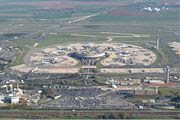


Extravagantly so. Terminals, passageways, flight information screens, water towers, taxi-ways -- it's one futuristic curving swoop after another. The plan of the whole place is round. Other examples abound. From the eastern bloc, we have the embodiment of communism's triumphant future, Sputnik.

In contrast, we have many examples of non-round visions of the future ending in failure or obsolescence, most notably the wedge-shaped angularity of rusted, underpowered 1970s automobiles


So what does all this have to do with bureaucracy and management consulting? Everything. Bureaucrats toil in misery in square, dimly lit cubicles. They drown in reports full of lists, tables, and bar chars, all square, defined, and limited. The quintessential artifact of the bureaucratic craft is the organization chart -- people in boxes tethered to the hierarchy, defined by their function, not their essence or aspirations. But bureaucrats dream, and when they do, they dream of the future. A future where things go smoothly, processes flow unimpeded by insecurity, ineptitude, or turpitude. A future that is ... Well I'll let you guess.




Now a cynic might say that this what you get in a society ruled by marketers schooled in conformism. But no, I say it is something else. It is a yearning, for a voluptuous, pneumatic, curved ideal, rejecting the piercing angularity of the past, embedded deeply in all of us. Without knowing it, when we speak of revitalization and change in the corporation, we express ourselves in the visual language of visions of the future. Heck, it might even be genetic, a sort of transformational grammar of the visual. Somebody get me Chomsky, stat! Anyway, I have seen the future, perfected, and it is round.


Extravagantly so. Terminals, passageways, flight information screens, water towers, taxi-ways -- it's one futuristic curving swoop after another. The plan of the whole place is round. Other examples abound. From the eastern bloc, we have the embodiment of communism's triumphant future, Sputnik.

In contrast, we have many examples of non-round visions of the future ending in failure or obsolescence, most notably the wedge-shaped angularity of rusted, underpowered 1970s automobiles

and post-war public housing projects.

So what does all this have to do with bureaucracy and management consulting? Everything. Bureaucrats toil in misery in square, dimly lit cubicles. They drown in reports full of lists, tables, and bar chars, all square, defined, and limited. The quintessential artifact of the bureaucratic craft is the organization chart -- people in boxes tethered to the hierarchy, defined by their function, not their essence or aspirations. But bureaucrats dream, and when they do, they dream of the future. A future where things go smoothly, processes flow unimpeded by insecurity, ineptitude, or turpitude. A future that is ... Well I'll let you guess.
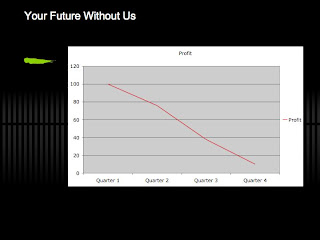
To illustrate, let me first tell you the true, inner secret of Powerpoint presentations: They are all the same. They come in many colors, jargons, and templates, but they all follow the same story arc. They foretell two futures. One is the path you are on today, and where it will lead you without the guidance of the presenter. It is full of loss, disharmony, and suffering. The other offers the possibility of redemption, renewal, and remuneration and can only be reached through the wisdom of the elders and their knowledge of best practices. Something like this:


Now a cynic might say that this what you get in a society ruled by marketers schooled in conformism. But no, I say it is something else. It is a yearning, for a voluptuous, pneumatic, curved ideal, rejecting the piercing angularity of the past, embedded deeply in all of us. Without knowing it, when we speak of revitalization and change in the corporation, we express ourselves in the visual language of visions of the future. Heck, it might even be genetic, a sort of transformational grammar of the visual. Somebody get me Chomsky, stat! Anyway, I have seen the future, perfected, and it is round.
Saturday, February 23, 2008
R.I.P. Peter S. Albin 12/20/1934-2/20/2008
My father Peter Steigman Albin died on Wednesday February 20, 2008 after a long illness. Below is the text of my Eulogy to him.
.........
Before I move on to what I have to say about Dad, I’d like to acknowledge a few people who made an enormous difference in the quality of his life in the years since his stroke.
First, his friend and colleague Duncan Foley, who continued to see light in Dad when so many of us could only see darkness. Duncan has also asked me to read a few words he wrote: Pete Albin had a big effect on my life both as my collaborator in scientific work and as a human being. I will leave the scientific issues for another time. What Pete lived through remains astonishing to me. His experience in the small way I was able to understand it, was uniquely cruel and powerful. I cannot miss his suffering, but I will miss him. As the Quakers say, let us hold Pete in the light.
To Gerard Trebot, who provided camaraderie under extraordinary circumstances and showed us all how to see not only what Dad needed from us, but what he could still give us.
To Doctor James Robilotti for his wisdom, compassion and friendship.
To Doctor Gary Inwald who saw hope where others saw futility.
To Doctor Chris Fabian, for his calm counsel
And most of all to my mother, Pat Albin. Those closest to our family know the heroic sacrifices she made. I can only marvel at her strength and kindness.
To all of you, I offer you my deepest thanks and express my admiration for the examples you have set as human beings. Many others helped, but without you, Dad would have died many years ago and would have had many fewer moments worth living.
….
It’s tempting to talk about Dad from a particular perspective – colleague, family member, friend, teacher, but choosing any one of those seems not merely insufficient to me, but wide of the mark. As is true of anyone, Dad was of course more than the sum of his parts, but I think one of the things that set him apart from the rest of us with multiple interests is that in essence, there weren’t any parts, only the whole. Whether he we was delving into the most abstract of mathematical constructs, raising children, telling a joke, becoming a master go player, carrying on an ordinary conversation, or just staring out the window, he brought to bear the same combination of attention, rigor, eclecticism, humor, and Rabelaisian gusto.
Staring out the window is a particularly illustrative example, because it’s something he did a lot, and it was for him an exceptionally fruitful activity. For many years, he would look out the picture windows of our 22nd floor living room and watch the landscape below him be transformed by construction. This culminated in the site excavation and then construction of the NYU gymnasium in the late 70s. As he watched the work unfold, he became more and more fascinated, eventually bluffing his way onto the jobsite and getting to know both the labor and management sides of the operation. This led to a series of papers on the differences between the way engineers and workers approach problems of optimization and queuing.
His conclusion was that the traditional management-science approach of traveling salesmen and linear programs didn’t capture the richness of what was going on and wasn’t any more effective than letting the front-end loader operator decide by himself how many trucks were needed on-site. He laid this out with his characteristically idiosyncratic symbology. All while sitting around in his speedo-style underwear, drinking pots of coffee, puffing away on pipes of varying contents, while listening to WBAI on the radio and bullshitting with his teenaged son. There was no incongruity to this multi-tasking across the spectrum from sublime to ridiculous, though. No contradiction in any of his dimensions, habits, virtues, or vices. It was all simply Pete.
I think this captures the essence of how he approached his more theoretical and intellectually challenging work, too: First, he liked real-world examples. Second, he thought that cognitive and information sciences that try to model how people actually think have a better shot at representing the way people solve problems and interact than the “incomplete” formalisms of traditional models of rationality. Third, standard economics terminology never quite worked for him; he always needed his own. Fourth, he couldn’t just sit in an office and crank things out. He needed coffee and conversation to develop an idea. He needed distraction, hustle, and bustle, before he could settle into his night-owl productivity.
The other thing, which is very hard to recognize if you didn’t really know him in more than one context, is that there is an earthiness and whimsy in the way he presented his ideas. His writing is full of neologisms, circumlocutions, and odd constructs. In someone else, this might just be jargon, but in him it was a form of wordplay and a source of amusement. Dad punned and kenned on paper and in person with abandon, regardless of context. I often sat with him as he worked, and watched a smile play across his face, or even heard him chuckle as he scrawled away in felt tip. Looking at these sentences after the fact, I can’t say that I get the jokes, but I know they’re in there. The verbiage in his later work is drier, but the whimsy comes out in the illustrations. The meaning of the images generated by his simulations was almost secondary to him. He got a big kick out of the idea that his equations could produce such pretty pictures, and he often just showed people screen shots without trying to explain what they meant.
My thoughts about Dad as an intellectual often center around a conversation we had about the word “discipline,” in the sense of an academic discipline. This word represented everything he found most frustrating about academia. Working within a discipline meant restricting yourself, punishing your own mind when it strayed outside the boundaries set by the arbiters of the field. Deep down he was very ambivalent about the label “economist.” He was proud of the field’s intellectual rigor and admired many of its practitioners. He wanted to be known as someone who worked in the same tradition as, Keynes, Arrow, Galbraith. However, he kept being told (in reviews, grant applications, and job interviews) that he wasn’t working within the discipline. Maybe it was good mathematics, or linguistics, or computer science, but it wasn’t economics. He didn’t really understand why academics put themselves in bins like this. And though he craved the validation of his peers, he grew weary of the chase. Because of these frustrations, it never bothered him that his children didn’t follow in his footsteps.
I think I’ve said enough about the serious side of Dad, though, and I’d like to return to what I started to say about gusto. Here are some of the things Dad loved to do:
Swing a tennis racquet
Swing an axe
Eat haute French cuisine
Make Chinatown waiters bring him the dishes written on the walls in Chinese
Eat in greasy spoons, and declare that there is no such thing as enough bacon
Give talks on highly technical subjects
Consult with captains of industry and finance
Tell shaggy dog stories
Play absolutely any game
Listen to Bach, Wagner, and Beethoven
Sing “Barnacle Bill the Sailor”
Go to foreign movies
Go to plays
Go to the opera
Hang in out pool halls
Listen to Phil Rizzuto call a Yankee game
Read the great books
Read mathematics and physics texts
Read Linguistics journals
Read Gargantua and Pantagruel
Live like Gargantua
Organize anti-war protests
Read the Nation
Listen to WBAI
Listen to right-wing talk radio
Hang out in cafes
Hang out in museums and art galleries
Explore the wonders of cities
Sleep out under the stars in the country.
Come to think of it, he really liked to do almost anything, go almost anywhere, and talk to almost anyone because all knowledge was good, and to him, accessible. Any activity offered new skills to be mastered, new people to meet, and new places to explore. Growing up with someone so filled with wonder and fascination at the world around him, who was also equipped with such astounding powers of understanding and communication was an extraordinary privilege. It was also an extraordinary to privilege to feel my esteem being reciprocated, a feeling I’m sure many of you share.
I’m not going to say that he was a saint, or that there was never friction between us, or that he wasn’t at times enormously frustrating to deal with. But I knew from very early in life that he had rare gifts as a parent and human being. As I grew into adulthood I recognized more in the way of feet of clay, but I never really lost the sense that he was sui generis, and above all, fun. He remained the person I most enjoyed spending time with, up until the moment in August of 1991, when so much of that was taken away, not just from him, but from all of us.
It has been very hard to find perspective on Dad’s long and brutal illness. It is hard to imagine a crueler fate than to be a polymath and athlete who retains only enough of his mind and body to know what he has lost and be unable to do anything about it. The last 16 years have been a punctuated equilibrium of decline, with each crisis bringing lower baselines of health and function and erasing more of what Dad once was. In this context I have struggled to maintain my best memories of him, but this is a struggle that has to be taken on. I believe in a sort of life after death. By this, I don’t mean that I believe in god, or the spirit world, or any metaphysical sense of “soul.” Trust me, it is impossible to imagine that the grandchildren of Joe Albin or the children of Pete Albin would.
What I mean is that the influences of the people in our lives are not simply winds or waves that knock us one way or another as they pass. As much as a child carries the DNA of his parents, we all carry the words and deeds of those who shape us physically, emotionally, and intellectually. These can be a burden, or they can be a blessing. Dad’s influence was overwhelmingly the latter for me. I have a mind that he in large measure taught me how to use. I have a love of the intellectual, the physical, the aesthetic and the comical. Most of all I have memories of his shaggy grin as he picked me up from school, joined me on climbs in the four corners, or walked up to me after a gig and said “now I know how Keith Richards’ mother feels!” I would like now to leave you all with a simple request. Keep the best of Dad alive inside you, the whole thing.
Saturday, February 02, 2008
Oh No!Not Another Mac vs. PC Blog Entry!
Given how I'm old and all, I've been using computers for a long time, strictly PC's, going back to the days of MS-DOS. I can't say that I've ever been religious about it, but PC's have been the logical choice. I used to do a lot of development (mostly in MS Access, which is highly platform dependent), and to the extent that I sometimes brought work home from the office, strict compatibility, without having to think about it was a virtue. I used other people's Mac's occasionally, but failed to see what all the fuss about (and really didn't like one-button mice).
Recently, my wife has significantly ramped up her level of computer usage, and for the first time, we really needed a second machine. My own requirements have changed. I really don't do any development anymore, and am most interested in doing more writing and more music production. Time constraints aside, I had largely given up on music on the computer. Multi-track audio on a PC that has to run a lot of other software and be shared by multiple users really is a pain in the ass, and I have completely lost whatever capacity I once had to fight with the assininity that is the way Windows configures stuff. I also wanted a laptop rather than another desktop machine.
Putting all these thoughts together, it became clear to me that it was time for a Mac, a specifically, a MacBook. Even though at first blush
Part of me really resists this because I absolutely despise cult marketing, Apple's in particular, and don't want to reward it with my business. Mac's also appear to be (significantly) more expensive at first blush. But after doing a bit of due dilligence, it became clear to me that a PC laptop comparably configured to a MacBook is really not much cheaper. It used to be impossible to figure out what "comparably configured" really meant, but now that Macs use Intel CPUs (and only the high-end ones), um, apples to apples comparisons are much more straight forward.
The other real kicker is software. Mac comes bundled with a multi-media suite called iLife that achieves a level of integration and interoperability that's comparable to what MS Office achieves with "productivity" software. iLife includes something called GarageBand, which for me turned out to be the coup de grace. GarageBand is what's called a "digital audio workstation" -- basically, a recording studio in a (virtual) box. In its first few releases, it was basically a toy, dumbed down version of a DAW, but the latest release is a whole 'nother story. It has all the functionality I will ever need, is free, and requires no configuration because it comes pre-installed and guaranteed to work. There is nothing comparable out of the box in PC land. OK Mr. Jobs, you can have my credit card number now, but please, no more of those stupid PC drone in a suit vs. Mac hipster in jeans commercials ...
The other big seller with GarageBand is that it includes it's own collection of synthesizer sounds, and "loops" that are tightly integrate with the rest of its functionality, as opposed to DAWs that treat these things more as ancillary "plug-ins" that require more in the way of getting the pieces to talk to each other. In practical terms, this means that for someone like me who is neither a competent keyboardist nor drummer, I can build tracks that have fairly convincing fake drums and keyboards much more easily than I could in the DAW packages I had used previously. At some point I may actually detail some of this, but for now, evidence of my first efforts with GaragBand is below. Several other generations of audio production technology are represented here.
Wednesday, January 16, 2008
Guns or butter?
Pardon the political intrusion, but every once in while one of my more deeply buried multiple personalities, which cares about these things, manages to seize the conn ...
Prior to the election of 2000, one of the bits of conventional wisdom was that there wasn't a dime's worth of difference between Gore and Bush. One of the bits of conventional wisdom that came to replace this (as the Bush regime plunged us into war abroad, alienated us from our allies, ravaged freedom at home, and put a hurting on the polar icecaps) was that there was in fact a huge difference between the two. As someone who voted for Ralph Nader, I've done penance for this for many years. I'm willing to concede that there was indeed a larger denomination of difference, and I think the world is a worse place for having been subjected to going on eight years of shrubbery. Still, as a new silly season bears down upon us, I'm once again left to ponder how much difference there really is between one side and another.
For instance, Giuliani has anointed himself the heir to Bush's militarism, authoritarianism, contempt for dissent, and rejection of the sovereignty of other nations. He seems to like fetuses a whole lot more than he used to, and is looking forward to owning beach front property in Dutchess County. In contrast, we have the populism of Edwards, whose positions can best be summarized by writing down a list of Bush's policies and inserting the word "not" before every verb. Then there's Huckabee, the absurd holy roller, and Hillary the soulless technocrat. It's easy to find dipole pairs of elephants and donkeys, (or elephants and elephants or donkeys and donkeys) and compare and contrast until the cows come home.
Ultimately, though, this is a fool's errand because the terms of debate are so constricted. On the environment, the battle lines are drawn over which pseudo-alternative energy technologies will be subsidized. On issues of "security", the question is which restrictions of the Patriot Act will be retained. On health care, it's a matter of nibbling at the edges of the absurdity of a system built on the inherent conflict of interest between for-profit insurance paid for by employers and sick people.
But perhaps greatest lost opportunity is the war because no candidate or other significant figure in the mainstream has taken the matter beyond the questions of "what were Bush's reasons for going to war?" and "how long should we stay in Iraq?" None of them asks "why militarism at all?" In this domain, I really think they're all minor variants on the same theme.
Suppose any of the three big lies of the war (WMD, Saddam hearts Al Qaeda, democracy flowering in the desert) had a shred of legitimacy, and the cases for any were not manufactured entirely out of whole cloth. Would any of the candidates of either party (except maybe Kucinich, who doesn't really count) oppose the war, even as currently prosecuted? Frankly I doubt it. I think some of them were and/or are troubled by Bush's deception and with the way he actually did things on the ground. But to say that you're against the war now because it turns out Bush was bullshitting (or to say that you were against it at the outset because of concerns about the particulars) is really to say that you accept that there is a case for invasion other than pure self defense and that aggression is an appropriate tool in our international relations kit.
A true opponent of the war would say that even if everything Bush had said Iraq in 2003 had been true, he would have voted against invasion, and taken personal risks to make his opposition known. Of the big three Dems, only Obama can get away with saying he opposed it from the beginning, but if you read his published positions more closely, you can see that he's hedging his bets. He says he was against the war because he didn't think it would work as conceived by Bush, and because it drew resources away from the more important conflict in Afghanistan. Those are certainly valid positions, but they strike me as entirely inside the Beltway.
Looking at how he proposes to end the war, I see more of the same. He says he'll immediately begin withdrawing "combat" troops and not build "permanent" U.S. military bases (good), but it's clear that he intends to maintain a sizable American military presence. More importantly, there's nothing in his budget positions about reducing the level of military spending in Iraq or anywhere else. Edwards and Clinton have very similar positions (though it took both of them quite a bit longer to arrive at theirs).
Each of the big three (and even in some ways a couple of the Republicans) also makes populist noises about making the country a better place by tinkering with the welfare state. They even all offer "plans" to fund these changes. In reality, though, all they really do is spout a bunch of platitudes about taking back the Bush tax cuts and cutting pork barrel spending. None of them really talks about the kind of fundamental restructuring of national taxation and spending policy that would be needed to make us a bit more like Canada or (heaven forfend) France.
So let me just say up front that in some ways I would like this country to be a bit more like France. I say this out of pure selfishness. I have elderly, infirm parents, a young child, I'm not rich, and my prospects for financial reversal (absent winning lotto) are dim. I would like my parents' modest estate to live as long as they do, and maybe even a bit more. I would like my son to be able to go to a good College and enter a career without debt. I would like to be reasonably sure that if I keep working more or less as I do now, I can stay more or less in the middle class. I would like the air we breathe and the pace of the lives we lead to be a bit gentler. None of these is even close to a certainty within the means at my disposal, and I am well above the median household income. If I lived in France, it would be. One option would be to move to France, but there are reasons not to, not the least of which is that I actually like this country.
There are five things that I think could bring these meager dreams a bit closer to reality, and I don't think any of them should require us to stop pronouncing the last letters of words:
- High-quality, free education from infant daycare all the way through university
- "Single payer" comprehensive, universal health insurance, not linked to employment
- True medical coverage for the elderly (without all the gaps in medicare, and including coverage nursing homes),
- A national plan for improving mass transit and reducing car usage
- An energy policy centered around reductions in consumption rather than exploitation of new resources.
In other words, your basic left- liberal agenda. None of this is actually all that radical in light of the things that large numbers of Americans actually say they want. Some might require us to rethink ideas about freedom of economic choice. Some might challenge commonly held ideas about moral hazard and entrepreneurship. All of them would require vast changes in spending at all levels of government.
Okay, so now go ahead and call me a tax and spend liberal. The thing is, though, I don't think that tax increases are the answer to any of this. Another bit of conventional wisdom is that France (and Germany, and Sweden, and Holland ...) can all afford generous welfare states because they have much higher tax rates than we do. Trouble is, this isn't true. Various studies show that if you factor in the total tax bite (including taxes on real estate, sales, state and local income etc.), America falls somewhere in the middle. Tax havens like Switzerland pay a lot less than we do, but on average, it turns out that Americans' total tax rate is about the same as Germans' and Frenchmen's.
The big difference is that the typical middle-class German or Frenchman actually receives some direct services that have a real bearing on quality of life from the national government. In contrast, non-retired middle-class Americans basically get nothing from the feds. So what do we get that Europeans don't? We get a military. A really big one. Big enough to fight major wars on multiple fronts without resorting to conscription.
We have been trained to believe that this is something that we need and can afford. The truth neither is the case. As our rising national debt makes clear, we definitely can't afford it. The rhetoric about the irresponsible Bush tax cuts are a bit of red herring. Sure, they've made a difference (especially in out-year projections), but the real hit to the Federal budget has been Iraq. Pretty much nobody but Bush disputes this.
But what about the need part? We need a strong defense don't we? Okay, we do, but not this strong for two reasons. First, the level of "preparedness" is wildly disproportionate to the threat. The cold war is over. The greatest threat to our survival is no longer military. It is economic (i.e., China, and soon India). We need enough military to make anybody think twice about fucking with us or our most important or favored allies. We'd have that if we spent a quarter of what we spend now.
Second, and perhaps more importantly, having a huge military tempts us to use it. Our national mythology is that we fight on the right side and enter wars to rescue the downtrodden from tyranny. Truth is, we've done that relatively few times, and during the eras when we've had growing standing armies we've tended to use them to overthrow governments and install dictatorships. Sweden used to do this to, 300 years ago, when they had an empire. Now they have Ikea, and life is good.
To tie this all together, what I would like to see in the campaigns is a real discussion of how our government should set priorities. Do we want to fill the hole in the medicare donut, leave no child's be ... uh leave no child behind, improve our transportation infrastructure, put our country back at the top of the basic research charts, land on Mars ...? Well we can't do all (or most) of those things and be orders of magnitude more militarily large than the rest of the world combined. I would like to see every presidential hopeful present a pie chart of how he would allocate the current federal budget among major priorities. Use the current CBO revenue estimates. No fudging about new revenues from better tax compliance or cutting bridges to nowhere in Alaska. Given a pie the same size as the real thing, how would you cut it. This would force them to confront what they want out of a military, and how much they're willing to pay for it.
Okay, I know. Nader isn't running this year.
Saturday, December 22, 2007
Chapter 7 – Where’s Crazy Joe?
This is chapter seven of a novel in progress called "Uncivil Service." The previous chapter can be found here The novel begins here.
Shitonya turned to my captors and said,
“That’ll be all boys. I’ll be sure to let Mr. Maudlin know what a fine job you’ve been doing keeping the premises secured.”
Gorilla number one then released me from my shackles, he and his partner turned and walked away without another word, and I found myself facing my liberator on the threshold. Too bad I hadn’t stopped to pick up flowers on the way in.
“So, should I let you in? You do seem like a bit of a risk to the operation.”
“Why Shitonya, after all these years I’m shocked to hear you think of me as anything but harmless.”
“Well, you have been known to do an honest day’s work from time to time, and your colleagues are not exactly happy about the precedent that sets.”
“Flattery will get you no where, toots, let me in. I’ve got pointless tasks to complete.”
“Sweetie, you better not call me ‘toots’ or I’ll have the sensitivity police on your ass, and a few other places, too.”
“Promises, promises. It’s tempting but I think I’ll have to pass.”
With that, she turned on her heel and headed down toward her desk a few steps from the door, leaving the coast clear for me to steal into my place of employ.
Before turning into my own office, I stopped in front her desk.
“So where’s Arthur? I’ve got a meeting with him in five minutes.”
A half shriek half rasp sound rose from behind me. It was Mauldin love interest number one, Altoona.
“Oh, he called about a half an hour ago. Said he won’t be in until after lunch, and that you should start the meeting without him.”
“I’m supposed to start a meeting that’s supposed to be just me and him without him? How’s that gonna work? You know I can’t keep to an agenda.”
“Don’t ask me, babe. Figuring things out is not in my job description. You’re on your own with that one.”
I was about to throw some out some questions about why everyone above and below me in the chain of command was either missing or killed in action. Something told me not to trust Altoona and Carboña with those kinds of thoughts, though. I turned into my office, threw my jacket in the general vicinity of a coat rack and sat down behind my desk. Shitonya was the one to talk to about this. She was the only one in the office who did a lick of work, and the only one so far as I could tell, rebuffed the boss’s advances. She hardly ever gossiped, either, but her rumors were always on the money.
“Then I guess I’ll just have to make an executive decision. Meeting cancelled. Shitonya, can you come into my office for a minute please. I gotta do the asphalt orders myself this morning, and I need some help.”
“What are you talking about? You can do those things in your …”
“Shut up and close the door” I hissed at her.
“Ever since they started that new system over at Amici, I can’t keep the orders straight. I don’t know how Pats did it,” I said, perhaps only slightly exaggerating my usually befuddled tone for the benefit of the other two secretaries, who had perfect hearing, except for the sounds of their own phones ringing.
“Oh, you mean the new order forms. Here, I think there in this cabinet behind the door,” said Shitonya, clearly picking up on my ruse as she shut the door behind her.
“What are you talking about? There’s no new system. And what the hell happened downstairs?”
“I don’t know. You tell me. You managed to get in the door, how come I couldn’t?”
“The stupid ID things didn’t work, so I just walked in. The guards never stop me. When I got up here, the ID thing didn’t work on this door either, so I used the key I never gave back when they installed that thing.”
“What about the others? How did they get in?”
“Carboña and Altoona were already in when I got here. I didn’t ask them how. This happens a lot, and I think they have keys, too.”
“Yeah, I know, but nobody stopped you downstairs, and nobody ever stopped me before. I don’ know, but with everything I’ve been through, I’m getting a weird feeling about this.”
“What? You think it’s weird that somebody in our office gets murdered, and the security gets a little tighter? If you ask me, that’s a pretty good thing.”
Maybe I was being a little paranoid, or getting a little carried away in my new role as a homicide investigator, but it seemed to me that that wasn’t quite what was going on, and I said as much to Shitonya.
“Security’s getting tighter? So how come everybody gets in like usual except the one guy who talked to the cops, witnesses, and maybe the killer?”
“White, what the hell are you talking about?”
“What I’m talking about is this. Crazy Joe was in the apartment with Pats, alone. Maybe Pats was dead already, and maybe he wasn’t. He says he didn’t kill him, but he sure isn’t acting that way. He’s disappeared off the map. I’m the last guy that talked to him, and I’m the only one with any connection to Pats except his wife that had any connection to him. And that’s not all.”
With that, I started to tell her about Hunny, leaving out the underwear details. After all, who knew where the line between appropriate and appropriate lay. At first I also left out the details of her family tree.
“So lemme see if I got this straight. There’s this incredibly hot chick who used to be some broke dumpy married guy’s girlfriend and now she’s shacking up with you. And she’s trying to get you to solve a murder she’s afraid to talk to the cops about because she trusts you, a slightly less dumpy, slightly less married, equally broke guy?”
“That’s one way of putting it.”
“And you’re going along with it cause you’re a knight in shining fuckin’ armor right?”
“I don’t like to flatter myself, but you could look at it that way.”
“I’m not buying it. You’re an idiot who can’t take his eyes off a nice pair of tits, and is so desperate to get laid that he’d jump in to bed with a killer.”
With that, I looked up at her face (not that I’d noticed her tits), and started to contradict her.
“Look, maybe you’ve got a half a point about the tits (not that I noticed), but she’s not the killer, I didn’t jump into bed with her, and I’m not desperate. Just very particular, not that it’s any business of yours.”
“More to the story? Like what? She’s a member of the free frickin’ French resistance and you own a piano bar you ain’t telling me about?”
“What?”
“Casablanca was on the tube last night. It’s the best I could do.”
“Right actor, wrong movie. This is looking a little more like the Maltese Falcon. But trust me, this girl is in trouble, and if I don’t help her I could be to.”
“What are you talking about?”
“You don’t want to know anything more about her than that. I just need you to help me with one thing.”
“I’m not helping you with anything until you tell me the whole deal. Who is this girl?”
“Come on, you’re the only one who can help me with this, and it’s too dangerous for you ot know anything else.”
“Nothing doing. Spill it.”
I realized at that point that there was nothing else I could do. I couldn’t crack this case by myself, and if I was going to be taking on a partner, I couldn’t keep holding out.
“Her name is Hunny Pugliacci, and she’s afraid to go the cops, because she thinks her father might be involved.”
Shitonya let out a long whistle, then said:
“Vinny the Pooh’s daughter? Man you are in deep shit. If you’re stupid enough to get this involved, you’re definitely to dumb to get out of it by yourself. What do you want me to do?”
“Find Crazy Joe, and get him to come into the office, but don’t let him find out that it’s me who wants him.”
“You got it. But this is going to cost you.”
“She says she can pay. I’ll give you, uh, a quarter of what she gives me.”
“Fifty-fifty partner, and I got one more condition.”
“Yeah, what’s that?”
“Help me get rid of those to hos outside. Deal”
Under the circumstances, I didn’t see that I had much choice.
“Deal, partner.”
Subscribe to:
Posts (Atom)
